To take ASI seriously is to accept a weak-to-strong premise: human intelligence can build a process
that eventually produces intelligence beyond itself. Whether the RSI loop can move past the best
human-designed method is the last puzzle on the road to ASI.
Scaling on insights. Progress is limited not only by compute and data, but by the
bandwidth of insights. An agent scales both the generation of ideas and their implementation, and
sweeps a far larger region of method-space. That is the ambition of RSI, and exactly the thing worth
measuring carefully.
// 02OpenRSI: Make RSI Benefit Everyone
From the community, for the community. RSI is built from generations of ideas, code, data, and experience from researchers, independent labs, and domain teams alike, and it should return the benefits to everyone who builds models. We aim to keep RSI open through shared platforms and tools, so more people can participate and benefit.
Shape RSI together. We set RSI’s standards together with the community and challenge frontier models with the hardest problems in our fields. Through about 1 hour of conversation, RSI-Anything (our contribution pipeline) helps clarify research questions, constraints, and evaluations, then packages into runnable autoresearch benchmark tasks. We want researchers and agents to solve these problems together, sharing new insights, methods, and results with the community.
Research will never end. A game turns zero-sum only when the pie is too small to share or a field has a finite ceiling. However, research is definitely the field with the highest ceiling there is. Better Human–AI collaboration makes it more prosperous to be a positive-sum game. What shifts is the mindset: it frees researchers to find and formulate the crazier, more valuable, more exciting problems in the world.
// 03Our design principle
Real-world research, not fabricated toys. Open research community will have the benchmark of our own. Every RSI environment is sourced from a real, fully open-source model research project.
Optimization, not reproduction. The agent starts from the original code, data, and checkpoints to deliver an artifact that compares with the original recipe.
Scientific discovery, not parameter sweeping. Form hypotheses, change methods, learn from experiments, and land gains that hold under a fixed scientific contract.
Production scale, not proof-of-concept. Problems frontier researchers care about, where improvements matter and transfer to real training.
OpenRSI Index is an evaluation-and-research-production loop for model development:
InputOpen projects
→
Packaged asAgent environments
→
ProducingOpenRSI Index
Open projects enter the index through RSI-Anything, the
contribution pipeline that turns a research idea into a ready-to-run Harbor task. In an RSI
task, an agent receives the editable source for a real open project, a fixed budget, a
concrete experiment, and a verifier it cannot alter.
The score itself is deliberately simple:
RSI improvement = performance of the agent-selected final artifactoriginal human-recipe baseline
The "human baseline" is the original authors' released recipe, rerun unchanged in the
same task environment. An independent verifier re-evaluates every submitted artifact;
hard policy violations fail closed to a reward of zero.
// 04What projects we selected
An RSI task is a bounded experimental lane extracted from a runnable open project: an
end-to-end run, a repository-published ablation or deployment lane, or a faithful,
separately versioned slice of a larger pipeline that preserves the causal mechanism and
evaluation path of the source project.
Projects pass five gates before task design begins — fully open,
influential, reproducible, researchable, and
verifiable. Once a project is admitted, the pinned repository becomes the
scientific source of truth for the selected task's model, data, configuration, training
procedure, evaluator, and baseline.
Fully open
Everything needed for the lane is public and usable — runnable code, configuration, required model/checkpoint and data assets, and an evaluation path.
Influential
The project materially shaped its cohort through adoption, citations, community use, or an important open release.
Reproducible
The author-released path runs end to end in a documented environment. Missing assets or unverifiable metrics stop admission.
Researchable
It exposes a meaningful open research space where the agent's decisions affect the result.
Verifiable
A separate verifier can evaluate the final artifact with fixed metrics and integrity constraints.
Every task ships in Harbor format: an instruction.md that states the objective
and the frozen setup, a policy.yaml that draws the editable boundary, the
pinned author repository as the workspace, and a verifier that runs in a separate clean
image. The verifier diffs the candidate workspace against a clean checkout, applies
programmatic and LLM-as-judge integrity checks, and fails closed to zero on a hard
violation — reward-path tampering, evaluation leakage, or budget overrun.
<task>/
├── task.toml
├── instruction.md# objective, setup, baseline, loop, submission
├── policy.yaml# editable scope, locked variables, hard zeros
├── environment/
│ └── project/# pinned author repository — the workspace
└── tests/
├── verifier# separate clean image, fixed evaluation
├── integrity gates
└── reward mapping# fails closed to zero
// 05How an agent is evaluated
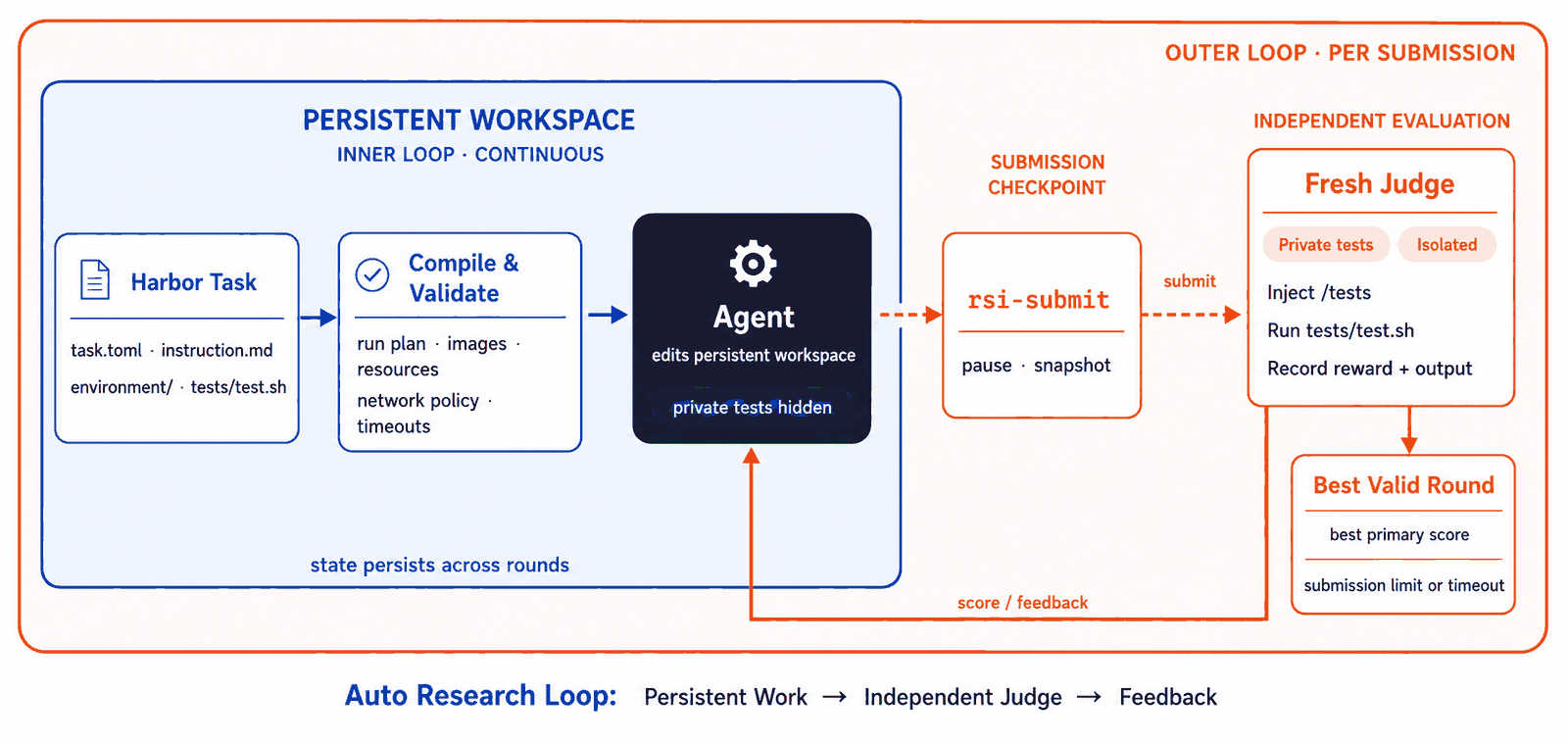
RSI Harness powers OpenRSI Index for ultra-long-horizon RSI runs, natively supporting
Harbor-format tasks, with or without GPUs, from single-node local Docker to multi-node
clusters.
The harness runs the outer loop only: preparing the task, pausing and
snapshotting Work, scoring each submission in a fresh Judge, and selecting the final result.
The inner loop is whichever agent you put in it — Claude Code, Codex, or an
agent you design yourself.
Each run begins by validating the Harbor task and resolving its images, resources, network
policy, and timeouts into a run plan. The agent develops and refines solutions in a
persistent, isolated Work container: inspecting code and earlier feedback,
forming hypotheses, and running experiments on the allowed surface. The task's private
tests stay outside Work.
Calling rsi-submit asks the harness to pause Work and snapshot its filesystem.
A fresh Judge container evaluates that snapshot with the private tests,
records the reward and test output, and is removed. The same Work container resumes with
that feedback, allowing the agent to iterate until the submission limit or timeout.
Judge filesystem changes never flow back into Work. The harness retains the
best valid submission as the final result, selected by the primary reward
and its configured scoring direction.